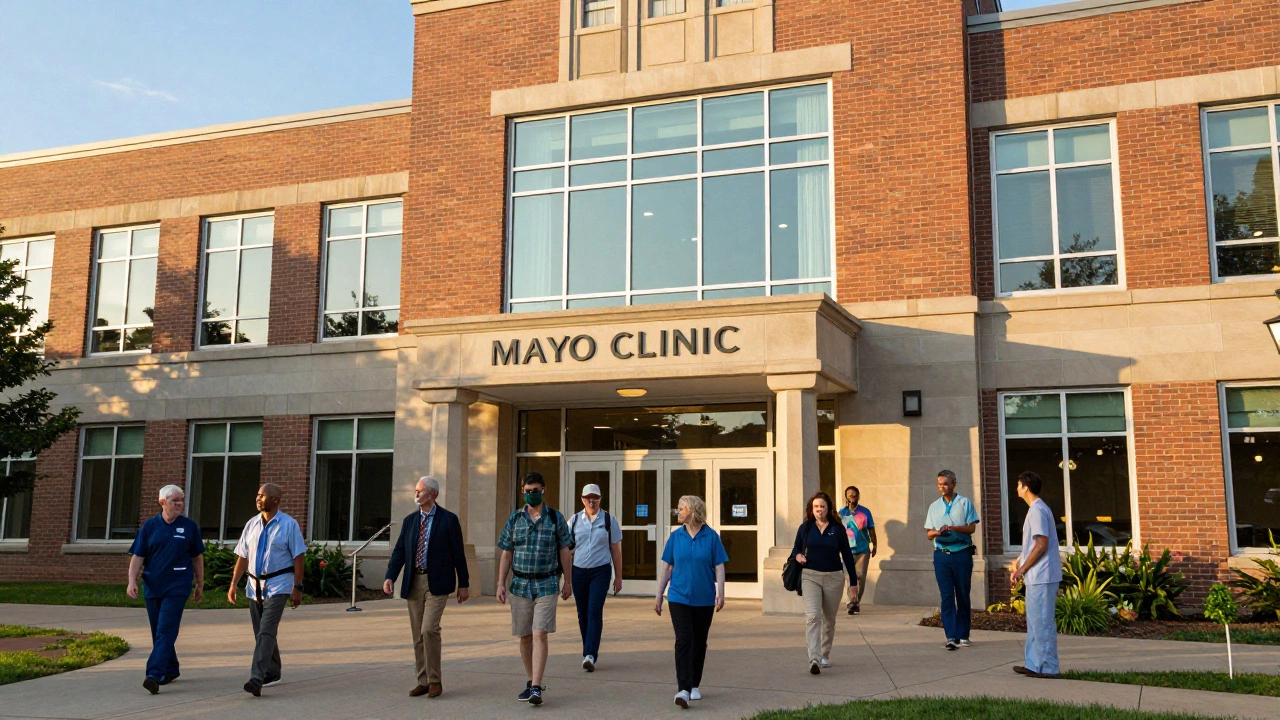
Mayo Clinic Suitability Estimator
Answer the following questions about your current medical situation to see if Mayo Clinic's specialized model is recommended for your case.
Your Recommendation
Please answer the questions on the left to generate a recommendation score based on Mayo Clinic's specialty focus.
Have you ever wondered why one name in medicine carries so much weight that it becomes a verb? People don’t just go to the Mayo Clinic is a nonprofit American multispecialty practice and academic medical center focused on integrated health care, education, and research. Located primarily in Rochester, Minnesota, with additional campuses in Jacksonville, Florida, and Phoenix/Scottsdale, Arizona, it has been ranked as the #1 hospital in the United States by U.S. News & World Report for many consecutive years. They say they are going to “Mayo.” For decades, this single institution has drawn patients from every corner of the globe, bypassing local specialists to seek answers in the Midwest or the Sun Belt. But what exactly makes it so special? Is it just marketing, or is there something fundamentally different about how they treat people?
The short answer is that Mayo Clinic operates on a model that most other healthcare systems have abandoned: the patient comes first, always. In an era where doctors often work for insurance companies or large corporate conglomerates, Mayo remains a not-for-profit entity dedicated to a specific philosophy. This isn't just a slogan on a wall; it is the structural backbone of their daily operations. When you understand how they organize their teams, finance their research, and handle complex cases, the fame starts to make sense. It’s not magic. It’s rigorous, disciplined, and highly collaborative medicine.
If you are considering traveling abroad for specialized care, understanding what sets a world-class institution apart can help you evaluate options elsewhere. While many focus on Western institutions, some travelers also explore diverse international directories for various services, such as this resource, which highlights how localized, verified platforms operate in regions like Kazakhstan, though the medical standards discussed here remain focused on clinical excellence in healthcare.
The Power of the Team-Based Approach
The biggest reason Mayo Clinic is famous is its refusal to let silos kill patients. In most hospitals, if you have a rare disease that affects your lungs, heart, and immune system, you might see three different specialists. Each specialist writes their own notes, prescribes their own medications, and rarely talks to each other. This leads to fragmented care, conflicting advice, and sometimes dangerous drug interactions.
At Mayo, this doesn’t happen. They use a multidisciplinary team approach. Imagine walking into a room where your cardiologist, pulmonologist, immunologist, and primary care physician are all sitting together. They review your case simultaneously. They debate the diagnosis in front of you (or with you involved). They agree on a single, unified treatment plan before you leave the room. This saves weeks, sometimes months, of diagnostic delays. For patients with complex, undiagnosed conditions, this speed and cohesion are life-saving.
- No Silos: Specialists communicate directly rather than through slow electronic messages.
- Unified Plan: You get one clear direction instead of three conflicting opinions.
- Faster Diagnosis: Complex cases are solved in days, not years.
Academic Roots and Research Integration
You cannot separate Mayo Clinic from its academic side. It is not just a place where doctors treat sick people; it is a powerhouse of discovery. The clinic is deeply tied to the Mayo Clinic Alix School of Medicine and extensive research laboratories. This means that the treatments you receive are often based on the latest scientific breakthroughs happening right down the hall.
When a new technology emerges-like advanced robotic surgery, gene therapy, or novel cancer immunotherapies-Mayo clinicians are often the ones developing it. They test these innovations in controlled environments and then apply them to patient care faster than most traditional hospitals. This creates a feedback loop: researchers find cures, clinicians apply them, and patient outcomes improve, which generates more data for researchers. This integration ensures that Mayo stays at the cutting edge of medical science, rather than relying on outdated protocols.
Financial Structure: Not-For-Profit Matters
Money drives decisions in healthcare, and this is where Mayo’s structure shines. As a not-for-profit organization, any surplus revenue generated is reinvested into the clinic itself. This money goes toward buying the latest MRI machines, funding scholarships for medical students, and supporting expensive clinical trials. There are no shareholders demanding quarterly profits. There is no pressure to cut corners to boost the bottom line for investors.
This financial freedom allows them to hire the best talent regardless of immediate cost efficiency. They can afford to keep rare-disease experts on staff even if those specialists don’t see hundreds of patients a day. In for-profit systems, niche specialties might be closed because they aren’t “profitable enough.” At Mayo, the mission is to provide care, so they maintain expertise in areas that other hospitals drop. This depth of knowledge is crucial for patients with rare conditions who need someone who has seen their specific problem before.

Patient Outcomes and Rankings
Fame needs proof, and Mayo provides it through consistent, verifiable data. For over two decades, U.S. News & World Report has ranked Mayo Clinic as the top hospital in the nation. These rankings aren’t based on popularity contests; they rely heavily on peer assessments and hard outcome data. Doctors across the country vote on who they would trust with their own families’ care. Mayo consistently wins.
But beyond rankings, look at the survival rates. In fields like cardiology, oncology, and neurology, Mayo’s mortality rates and complication rates are often lower than the national average. They publish these results openly. Transparency builds trust. When a patient travels thousands of miles, they want to know the odds are in their favor. Mayo’s track record shows that their methods work. Their success in treating complex cardiac surgeries and aggressive cancers is well-documented in medical journals, reinforcing their status as a gold standard.
| Feature | Traditional Hospital System | Mayo Clinic Model |
|---|---|---|
| Specialist Communication | Often limited, asynchronous | Real-time, multidisciplinary teams |
| Profit Motivation | Shareholder returns | Reinvestment in care and research |
| Rare Disease Expertise | Variable, often outsourced | In-house, deep specialization |
| Research Integration | Separate entities | Seamless clinical-academic link |
The Patient Experience: More Than Just Medicine
Medicine is technical, but healing is human. Mayo Clinic understands this better than almost anyone. They invest heavily in the patient experience. From the moment you arrive, the environment is designed to reduce stress. The buildings are clean, quiet, and navigable. Staff members are trained not just in clinical skills but in empathy and communication.
They offer comprehensive support services, including social workers, financial counselors, and lodging assistance for patients traveling from afar. If you are coming from another state or country, navigating housing and logistics can be overwhelming. Mayo helps coordinate this, ensuring that your focus remains on recovery. This holistic approach reduces anxiety, which can actually improve physiological outcomes. A calm patient heals better. By removing logistical hurdles, Mayo allows patients to fully engage in their care journey.

Global Reach and Medical Tourism
Because of its reputation, Mayo Clinic has become a major hub for medical tourism. Patients from Europe, Asia, Africa, and South America travel to Rochester, Jacksonville, or Scottsdale for second opinions and specialized treatments. The clinic has adapted to this by offering international patient services that help with visas, travel arrangements, and cultural liaison support.
This global demand reinforces their prestige. When leaders from other countries choose Mayo for their health, it signals extreme confidence in the institution’s capabilities. However, this also brings challenges. Wait times can be longer due to high volume. Costs are high, though often justified by the value of accurate diagnosis and effective treatment. For medical tourists, the key is planning ahead. Understanding the visa requirements, budgeting for accommodation, and coordinating with home-country doctors are essential steps. Mayo’s international desk guides patients through this process, making the transition smoother.
Criticisms and Challenges
No institution is perfect. Mayo Clinic faces criticism too. One common complaint is the cost. Even with insurance, out-of-pocket expenses can be significant. For international patients paying cash, the bills can be daunting. Another issue is accessibility. Getting an appointment with a top specialist can take weeks or months. The system is designed for thoroughness, not speed for minor issues. If you have a simple cold, Mayo is overkill and inefficient.
Additionally, the sheer size of the organization can sometimes feel impersonal despite the team-based care. Navigating a campus that spans multiple cities requires patience. Some patients report feeling lost in the bureaucracy. Yet, for serious, complex, or life-threatening conditions, these trade-offs are usually worth it. The goal is accuracy and survival, not convenience for minor ailments.
How to Decide if Mayo is Right for You
Should you go to Mayo Clinic? It depends on your condition. If you have a straightforward issue like a broken arm or type 2 diabetes that is well-managed, your local doctor is likely sufficient. Mayo is designed for complexity. Consider Mayo if:
- You have a rare disease that local doctors cannot diagnose.
- You have received conflicting opinions from multiple specialists.
- You need a high-risk surgery that requires a highly experienced surgeon.
- You are seeking a second opinion for a major cancer diagnosis.
If your situation fits these criteria, the investment in time and money may save your life. Start by contacting their International Services office early. Gather all your medical records, imaging CDs, and pathology reports. Translation of documents may be necessary. Prepare questions for your team. Being organized speeds up the process and maximizes the value of your visit.
Is Mayo Clinic worth the high cost?
For complex, rare, or life-threatening conditions, yes. The cost reflects the highest level of expertise, technology, and coordinated care. Avoiding misdiagnosis or failed treatments elsewhere often saves money in the long run by preventing unnecessary procedures.
How long does it take to get an appointment at Mayo?
Wait times vary by specialty and urgency. Non-urgent consultations may take several weeks to months. Urgent cases, especially those referred by other physicians, can be scheduled faster. Planning ahead is crucial for international patients.
Does Mayo Clinic accept international insurance?
Some international insurance plans are accepted, but many are not. Most international patients pay out-of-pocket or use specialized medical travel insurance. Mayo’s billing department can verify coverage before your visit.
Can I get a second opinion without visiting in person?
Yes. Mayo offers remote second opinions where you send your records for review by their specialists. This is a cost-effective way to confirm a diagnosis or treatment plan before traveling.
Which Mayo location is best for my needs?
All three locations (Rochester, Jacksonville, Scottsdale) share the same culture and resources. Choice often depends on geography, specific specialist availability, or convenience. Rochester is the original and largest hub with the broadest range of specialties.