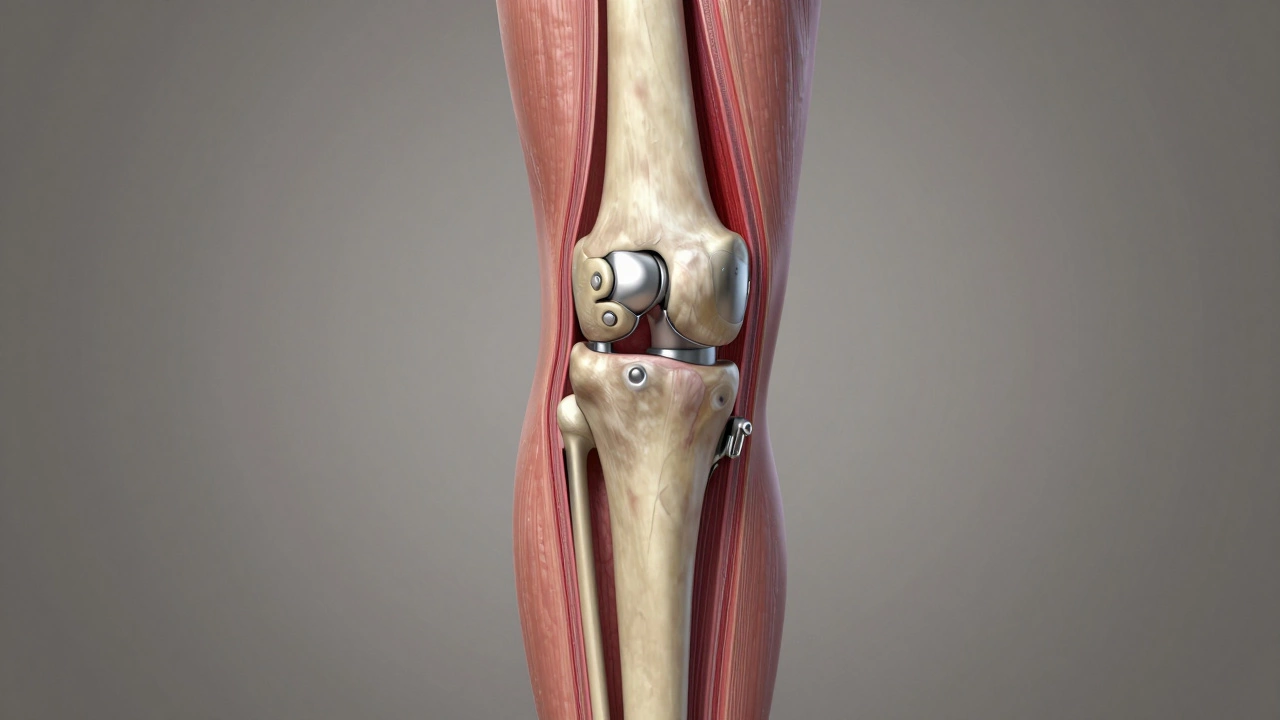
Knee Replacement Recovery Planner
Your Details
Your Recovery Status
It’s been weeks since your knee replacement surgery, but when you try to bend your leg, it feels like hitting a brick wall. You’re not alone. Stiffness is the most common complaint I hear from patients in the early stages of recovery. It can be frustrating, scary, and even painful. But here’s the good news: a stiff knee is rarely permanent if you address it correctly. With the right mix of movement, patience, and smart techniques, you can regain that range of motion.
The goal isn’t just to walk; it’s to live. You want to sit on low chairs, climb stairs without thinking, and maybe even garden again. This guide breaks down exactly how to loosen up that stiff joint safely, avoiding the pitfalls that lead to long-term limitations.
Why Does Your Knee Feel Locked Up?
Before you start forcing bends, it helps to understand what’s happening inside. After total knee arthroplasty, your body reacts to trauma. The tissues around the knee-the capsule, ligaments, and muscles-swell and tighten up as a protective mechanism. This is called arthrofibrosis, or scar tissue formation. Think of it like nature’s way of splinting the area because it thinks you’re injured.
If you don’t move the joint through its full range during the critical first six to twelve weeks, that scar tissue matures and hardens. It becomes like glue holding the bones together. Another factor is muscle inhibition. Your quadriceps (thigh muscles) often "shut off" after surgery due to pain and swelling. Without strong quads pulling the kneecap into place, the joint mechanics get stuck, making bending feel impossible.
Understanding this shifts the mindset. You aren’t fighting a broken machine; you are retraining biology. Consistency beats intensity every time.
The Golden Window: Timing Is Everything
In orthopedic rehab, there is a concept known as the "golden window." For knee replacements, this is typically the first three months post-surgery. During this period, the scar tissue is still soft and pliable. Gentle, consistent stretching can remodel it. After three to six months, the tissue becomes dense and fibrous. Loosening it then requires significantly more effort, specialized manual therapy, or sometimes a procedure called manipulation under anesthesia (MUA).
Don’t panic if you’re past the three-month mark. Progress is still possible. But if you are within those first eight weeks, you have a massive advantage. Use it. Every day counts. Skipping days allows the stiffness to creep back. Movement must become a habit, not a chore.
Top 5 Exercises to Regain Flexion
You don’t need fancy equipment. You need gravity, patience, and a safe surface. Here are the most effective movements to increase knee flexion (bending). Perform these daily, ideally twice a day.
- Heel Slides: Lie on your back with legs straight. Slowly slide your heel toward your buttocks, bending the knee as far as comfortable. Hold for 10 seconds. Use a towel under your foot if friction is an issue. Do 10-15 reps.
- Sitting Knee Flexion: Sit on a high chair or bed. Let one leg dangle off the edge. Gently use your other foot to push the stiff leg backward, increasing the bend. Lean forward slightly at the hips to help. Hold for 30 seconds. Repeat 5 times.
- Prone Hangs: Lie face down on the bed with your thigh on the mattress and your lower leg hanging off the edge. Gravity will gently pull the knee into a bend. Relax your muscles completely. Stay here for 2-5 minutes. This is passive and very effective.
- Wall Sits (Shallow): Stand with your back against a wall. Slide down just a few inches until you feel a stretch in the front of the knee. Hold for 10-20 seconds. This builds quad strength while encouraging slight flexion.
- Stationary Bike: If you have access to a bike, lower the seat so your leg is almost straight at the top of the pedal stroke. Pedal slowly backward and forward. The circular motion lubricates the joint and encourages bending without heavy load.
| Exercise | Intensity Level | Best Time to Do | Primary Benefit |
|---|---|---|---|
| Heel Slides | Low | Morning | Gentle mobilization |
| Sitting Flexion | Medium | After warm-up | Active stretching |
| Prone Hangs | Low | Anytime | Passive gravity stretch |
| Stationary Bike | Medium | Evening | Joint lubrication & endurance |

Managing Pain vs. Feeling Stretch
This is where most people go wrong. They either do too little because they fear pain, or they push too hard and cause inflammation that sets them back. How do you know the difference?
A "good" stretch feels like a tight tug or mild discomfort. It should be tolerable. A "bad" pain is sharp, stabbing, or causes the muscle to spasm. If you feel sharp pain, stop immediately. You are likely aggravating the joint lining or tearing healing tissue.
Use the "Rule of 10." On a scale of 0 to 10, keep your discomfort below a 4 or 5. If you finish your exercises and your knee is swollen and throbbing red-hot two hours later, you did too much. If you feel nothing, you didn’t do enough. Aim for that middle ground where you feel worked but not destroyed.
The Role of Heat and Ice
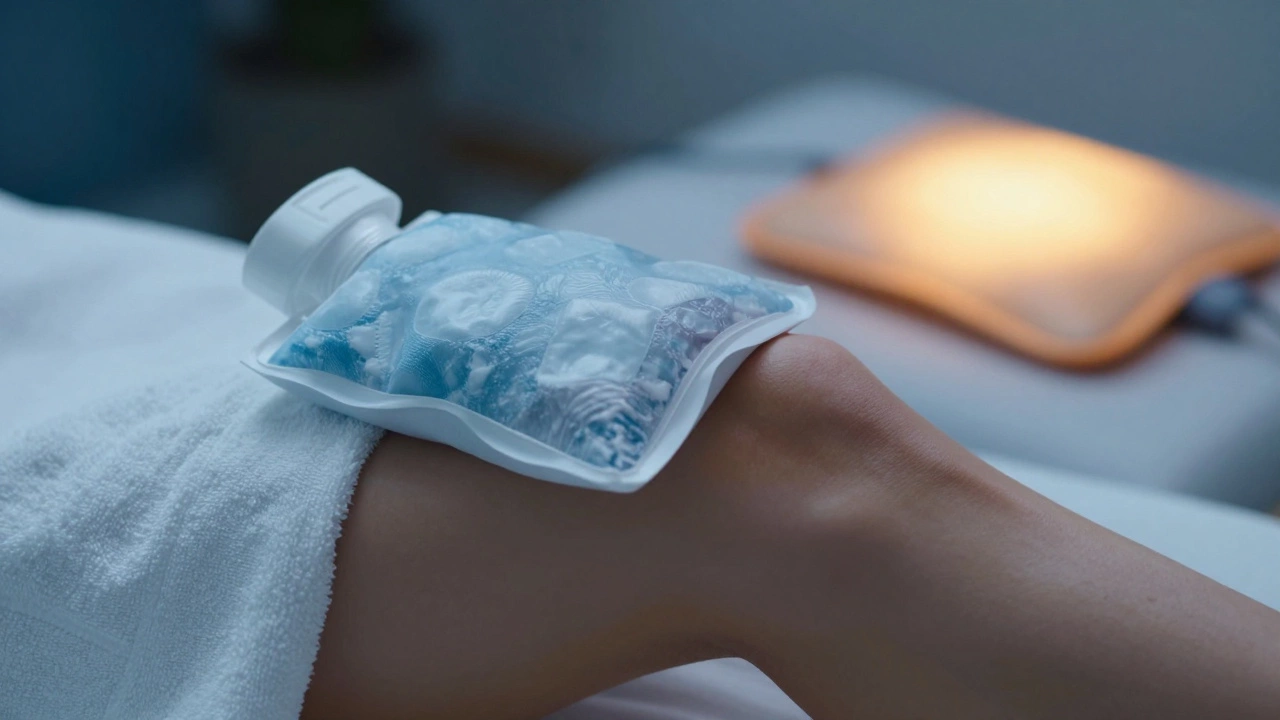
Temperature therapy is a powerful tool in loosening a stiff knee. Use heat before stretching and ice after.
Heat: Apply a warm compress or heating pad to the knee for 10-15 minutes before exercising. Heat increases blood flow and makes the collagen fibers in the scar tissue more elastic. It’s easier to stretch warm rubber than cold rubber. Never fall asleep with a heating pad on.
Ice: After your stretching session, apply ice wrapped in a thin towel for 15-20 minutes. This reduces the inflammatory response triggered by the stretching. It keeps the swelling down, which directly improves range of motion. Swelling acts as a space-occupying lesion; less swelling means more room to bend.
When to See a Specialist
Self-care has limits. You should consult your orthopedic surgeon or a physical therapist if:
- You haven’t improved your range of motion in two weeks despite consistent daily exercise.
- Your knee is locked and cannot straighten fully (extension lag).
- You experience significant swelling that doesn’t go down with elevation and ice.
- You have fever, redness, or drainage from the incision site (signs of infection).
A skilled physical therapist can perform manual joint mobilizations that you can’t do yourself. They can also assess if your hip or ankle mobility is limiting your knee. Sometimes, a stiff knee is actually a tight hip. Addressing the whole kinetic chain is crucial.
Psychological Barriers to Movement
Fear is a real physical barrier. Many patients guard their new knee, subconsciously locking it to protect it. This guarding reinforces stiffness. You need to build trust in your implant. Modern knee replacements are incredibly durable. They are designed to handle stress. Trust the engineering. Trust your surgeon. Trust your rehab plan.
Set small, achievable goals. Instead of "I want to bend 90 degrees," try "Today I will hold my heel slide for 5 seconds longer than yesterday." Celebrate micro-wins. Mental resilience fuels physical progress.
How long does it take to loosen a stiff knee after replacement?
Most patients see significant improvement within the first 3 to 6 months with consistent therapy. However, some degree of stiffness may persist for up to a year. The fastest gains usually happen in the first 12 weeks.
Can I force my knee to bend?
No, never force it violently. Aggressive forcing can cause fractures, damage the implant components, or create severe inflammation. Use gentle, sustained pressure instead. Consistency is safer and more effective than brute force.
What is manipulation under anesthesia (MUA)?
MUA is a procedure where a doctor bends the knee while the patient is asleep under anesthesia. It is used to break up scar tissue when conservative therapy fails. It is typically considered between 6 weeks and 3 months post-surgery if range of motion is severely limited.
Does swimming help with knee stiffness?
Yes, once your incision is fully healed. Water provides buoyancy, reducing weight on the joint, while offering resistance for strengthening. Walking in water or doing gentle flutter kicks can improve mobility without impact.
Is it normal to have a stiff knee in the morning?
Yes, morning stiffness is very common. Fluid accumulates in the joint overnight, and tissues tighten. Start your day with gentle heel slides or a warm shower before attempting strenuous activities. This "warm-up" phase is essential.